
AI Medical Assistant
AI-powered intelligent healthcare assistant for patient triage, appointment automation, and virtual medical consultation support.
Project Image
Project Overview
An AI-driven healthcare intelligence system designed to automate patient care workflows, reduce hospital load, and improve clinical decision efficiency.
Challenge
Healthcare systems struggle with long patient queues, delayed triage decisions, administrative overload, and maintaining accuracy under strict medical compliance requirements.
Solution
Developed an AI-based medical intelligence platform that automates symptom analysis, appointment scheduling, patient triage, and compliance-aware data handling.
Project Details
Key Features
- ✔AI-Powered Symptom Analysis Engine
- ✔Automated Smart Appointment Scheduling
- ✔Healthcare Compliance & Data Security (HIPAA-Level)
- ✔Multilingual Patient Interaction Support
Description
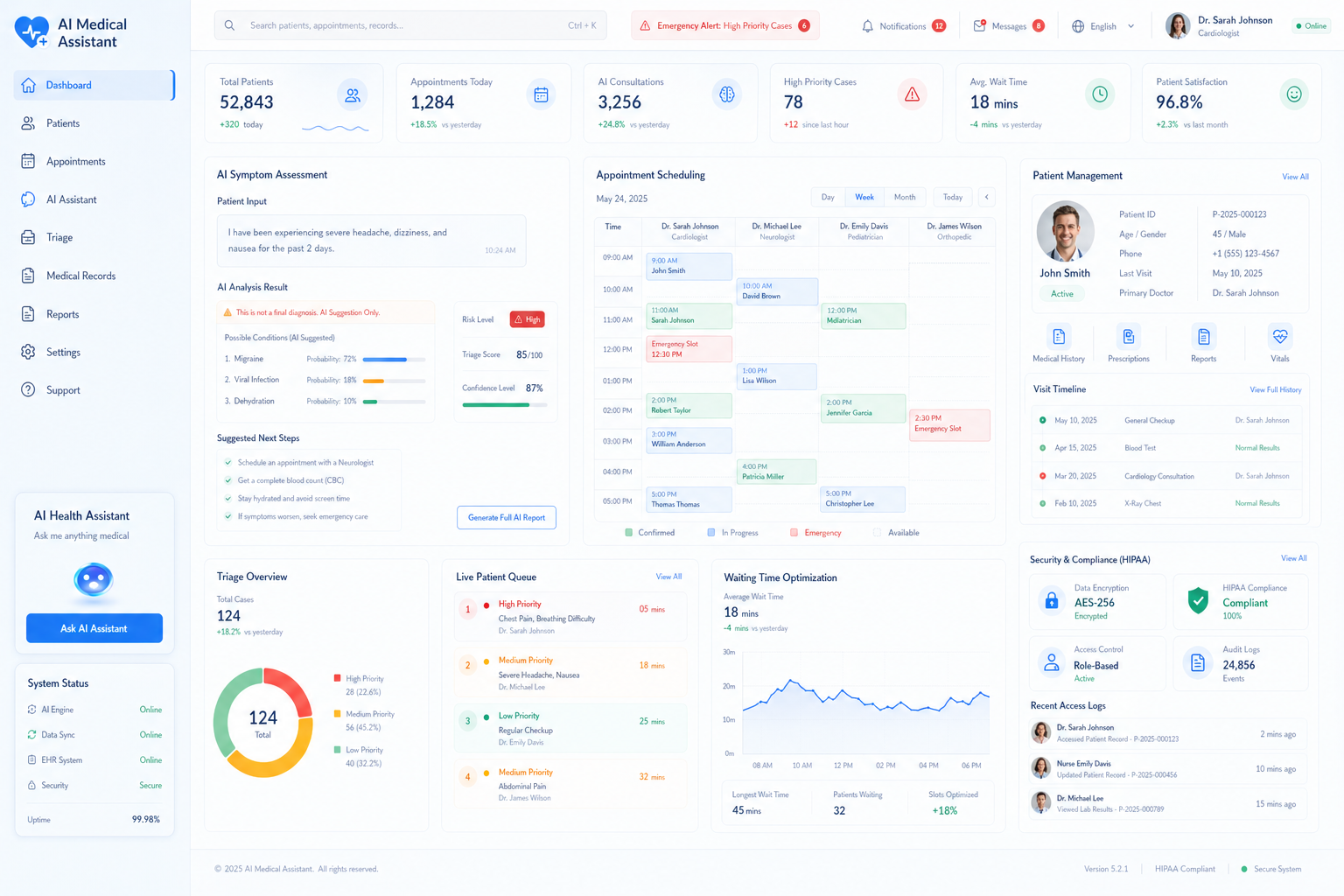
The AI Medical Assistant is a next-generation healthcare intelligence platform powered by artificial intelligence, designed to transform patient care delivery by automating diagnosis assistance, triage workflows, and hospital scheduling systems in real time.
Modern healthcare institutions face critical challenges including overcrowded hospitals, delayed treatment processes, high administrative workload, and difficulty in managing large-scale patient data efficiently. This system addresses these limitations through a fully automated and intelligent healthcare ecosystem.
At its core, the AI Symptom Intelligence Engine enables patients to describe their medical conditions in natural language. The system uses advanced NLP models to interpret symptoms and generate real-time urgency classification such as low, moderate, or critical, ensuring accurate triage prioritization.
The Smart Appointment Scheduling Module dynamically allocates doctor availability based on patient urgency, specialization requirements, and hospital workload. It ensures optimized scheduling by reducing wait times and prioritizing emergency cases automatically.
The Unified Patient Intelligence Dashboard manages large-scale patient records including medical history, prescriptions, diagnostics, and previous treatments, enabling healthcare professionals to make faster and more informed decisions.
A highly secure Compliance & Data Protection Layer ensures sensitive medical information is encrypted, access-controlled, and audit-tracked, maintaining strict healthcare data protection standards and regulatory compliance.
The system addresses inefficiencies in traditional healthcare workflows by replacing manual triage and scheduling processes with AI-driven automation that enhances speed, accuracy, and scalability.
The solution integrates symptom analysis, predictive triage, intelligent scheduling, and secure patient data management into a single unified healthcare AI platform.
From a design perspective, the interface is optimized for medical environments with a clean, minimal, and clinically friendly UI using calming tones that enhance usability for healthcare professionals and patients.
The platform is built for large-scale deployment across hospitals, clinics, and healthcare networks, supporting high patient volumes with seamless integration into electronic health record systems.
In conclusion, the AI Medical Assistant represents a major advancement in digital healthcare by combining artificial intelligence and automation to improve patient outcomes, reduce waiting times, and enhance overall medical efficiency.