
Hospital Management AI
AI-powered hospital operations platform for intelligent bed management, staff scheduling, and real-time resource optimization.
Project Image
Project Overview
An AI-driven hospital intelligence system that optimizes operational efficiency through predictive resource management and automated workflow coordination.
Challenge
Hospitals face constant pressure from rising patient inflow, limited beds, inefficient staff coordination, and poor real-time resource visibility, leading to operational delays.
Solution
Implemented an AI-powered hospital operations engine that uses predictive analytics for patient flow, intelligent bed allocation, and automated staff scheduling to maximize efficiency.
Project Details
Key Features
- ✔AI Bed Allocation System
- ✔Smart Staff Scheduling Engine
- ✔Real-Time Resource Tracking
- ✔Predictive Patient Flow Optimization
Description
The Hospital Management AI System is an advanced healthcare operations platform powered by artificial intelligence, designed to fully automate and optimize hospital workflows including bed allocation, staff scheduling, and resource management across large-scale medical facilities.
Modern healthcare institutions operate under extreme pressure due to increasing patient loads, limited infrastructure, and complex coordination between departments. Manual management often leads to inefficiencies, delays in treatment, and suboptimal use of critical resources.
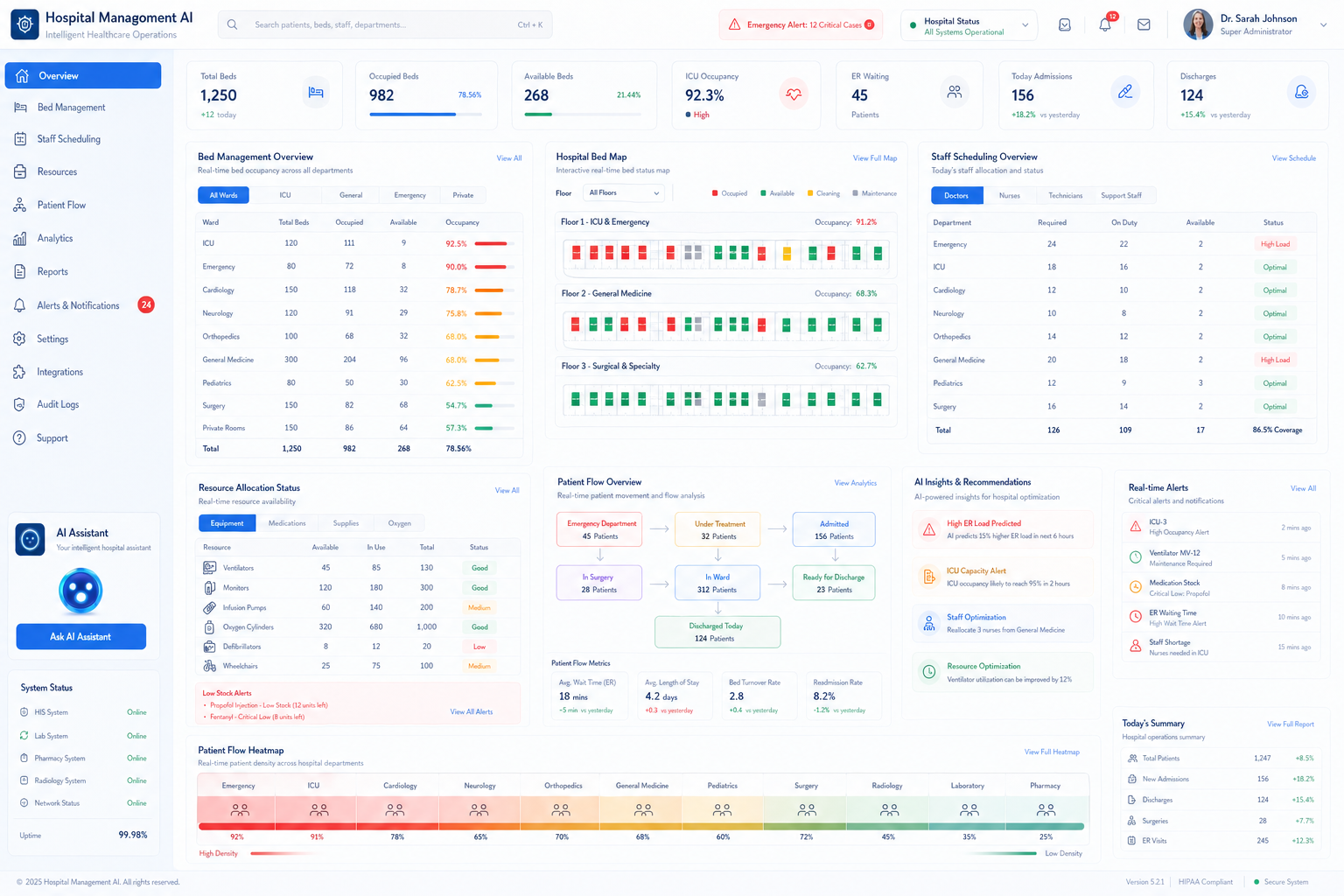
The AI Bed Management System continuously monitors hospital occupancy across ICU, emergency, general wards, and private rooms. It uses intelligent allocation models to assign patients to the most suitable beds based on urgency, condition severity, and resource availability.
The Smart Staff Scheduling Module automates workforce allocation by analyzing doctor and nurse availability, workload distribution, shift patterns, and departmental requirements. It ensures balanced staffing while supporting dynamic emergency reassignments.
The Resource Intelligence Engine tracks critical hospital assets such as ventilators, oxygen supplies, medicines, and monitoring devices in real time. It uses predictive forecasting to prevent shortages and optimize distribution across departments.
The Patient Flow Optimization System analyzes the complete patient journey from admission to discharge. It identifies bottlenecks, predicts congestion points, and provides AI-driven recommendations to improve throughput and reduce waiting times.
The system addresses core hospital challenges such as inefficient bed utilization, staff scheduling conflicts, and lack of real-time operational visibility, which directly impact patient care quality.
The solution integrates all hospital operations into a unified AI-powered dashboard that enables real-time decision-making, predictive planning, and automated workflow execution.
From a design perspective, the platform uses a professional healthcare dashboard UI with clean layouts and calm medical tones, ensuring clarity and usability for doctors, nurses, and administrators.
The system is highly scalable and designed for large hospitals with 1,000+ beds, supporting multiple departments and seamless integration with existing hospital information systems (HIS) and EHR platforms.
In conclusion, the Hospital Management AI System represents a complete transformation of healthcare operations through artificial intelligence, enabling hospitals to achieve higher efficiency, better resource utilization, and improved patient outcomes.